

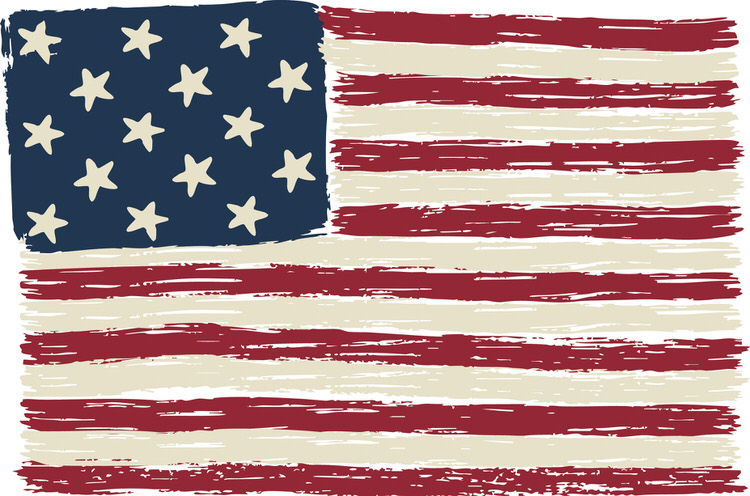
The Star-Spangled Banner, Fifteen Stars and Fifteen Stripes
Martin Bender
July 1813, Baltimore, Maryland: Major George Armistead, commander of Fort McHenry ordered two American flags large enough to be visible for miles, especially by ships approaching Baltimore Harbor. Congress declared war with Britain a year earlier in June 1812 because of British attempts to limit American trade with Europe, the impressment of American merchant seamen into service on British war ships, and territorial expansion conflicts.
A local flag maker, Mary Pickersgill, was contracted to make a storm flag measuring 17 x 25 feet at a cost of $168.54 ($3,508 in 2026 dollars). Also ordered was a much larger garrison flag measuring 30 x 42 feet costing $405.90 ($8,448 in 2026 dollars). With the help of Mary’s daughter, two nieces, and an indentured servant girl, the flags were completed and delivered to Fort McHenry on Aug. 19, 1813. Fifteen stars and fifteen stripes for the flag of the United States was specified by Congress in the Flag Act of 1794 after Vermont and Kentucky became states.
After the British burned Washington, D.C., in late August 1814, they turned their attention toward the city of Baltimore. On Sept. 12, British forces landed near the city but immediately encountered strong resistance by the American militia. The British suffered heavy casualties including the loss of their general.
Starting at 6:30 a.m. on the morning of Sept. 13, 1814, a naval bombardment rained down on Fort McHenry for 25 hours. Because of inclement weather throughout the day, the storm flag was flown over the fort. The weather improved by the early morning hours of Sept. 14 and the 30 x 42-foot garrison flag was raised on the fort’s 90-foot flagpole. Realizing they could not breach the city’s defenses and upon seeing the huge American flag declaring victory, the British withdrew.
“By the dawn’s early light,” Francis Scott Key, having witnessed the bombardment while detained on a truce ship, was elated by the sight of the stars and stripes still flying above Fort McHenry. He penned the poem “The Defence of Fort McHenry.” When the poem was put to music, both Key’s poem as a song and the Fort McHenry garrison flag became known as “The Star-Spangled Banner.”
With 20 states comprising the expanding United States in 1818, a new flag with 20 stars and 20 stripes was proposed. Congress eventually passed The Flag Act of 1818, which provided for a star for each of the 20 states and 13 stripes for the 13 original colonies. A star for any new state would be added on the 4th of July following the date of statehood.
The huge garrison flag that flew over Fort McHenry during the War of 1812 is on display in the Smithsonian National Museum of American History in Washington, D.C. With 15 stars and 15 stripes, The Star-Spangled Banner sewn together by Mary Pickersgill in July and August 1813 personifies to this day America’s values and resolve as “the land of the free and the home of the brave.”